

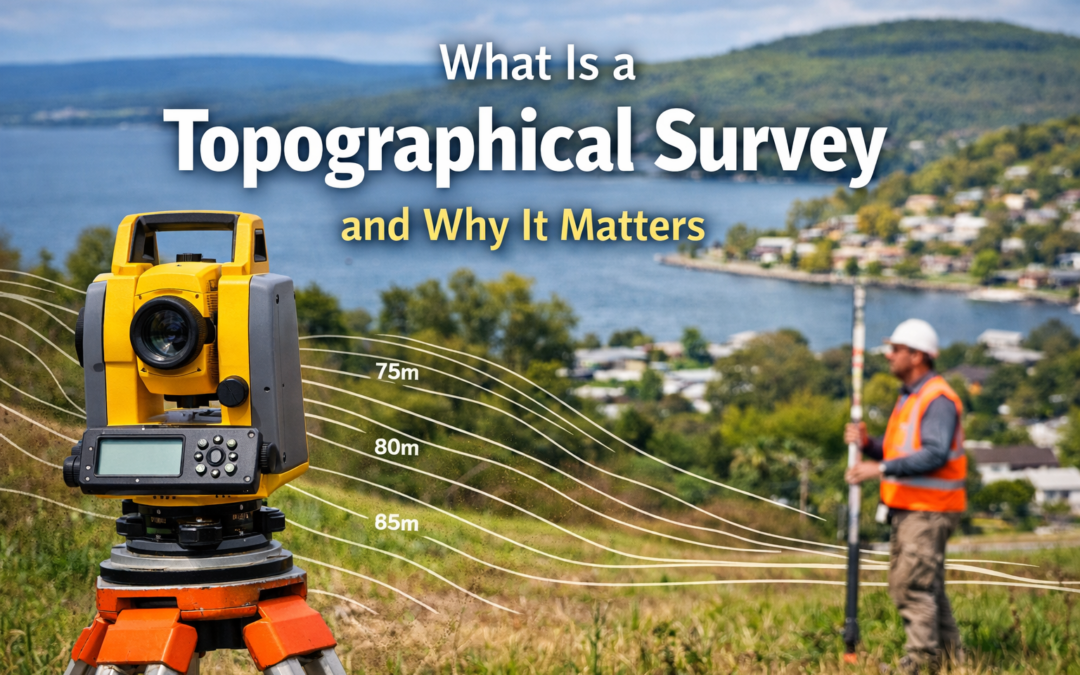
A topographical survey, often referred to as a contour or detail survey, is a detailed measurement of land that records ground levels, contours, slopes, and existing natural and man-made features. It provides a clear picture of how the land actually sits, which is critical before any design, construction, or development work begins.
For property owners, builders, architects, and developers across Lake Macquarie, Newcastle, the Central Coast, and neighbouring NSW regions, a topographical survey is often the first and most important step in a successful project. Without accurate site data, designs can be flawed, approvals delayed, and construction costs increase unnecessarily.
What Does a Topographical Survey Show?
A professional topographical survey captures the physical characteristics of a site in detail. This typically includes ground levels and contours, existing buildings and structures, fences and retaining walls, driveways and access points, vegetation, visible services, and drainage features. The result is a precise plan or digital model that shows how the land rises, falls, and interacts with its surroundings.
At MJM Surveying, our Topographical Detail Surveys are completed using modern survey equipment to ensure accuracy suitable for architectural design, engineering, and council submission requirements.
Why a Topographical Survey Is So Important
Understanding the shape and features of land is essential for informed decision-making. A topographical survey allows designers and engineers to work with the land rather than against it. It helps identify slopes, low points, and constraints early, reducing the risk of redesigns or unexpected costs during construction.
In areas like Lake Macquarie and the Central Coast, where land can be sloping, coastal, or environmentally sensitive, accurate contour information is especially important for drainage design, stormwater management, and building placement.
A topographical survey also supports smoother council approvals. Many NSW councils require accurate site information to assess Development Applications, subdivisions, and building works. Submitting designs based on reliable survey data significantly improves approval outcomes.
When Do You Need a Topographical Survey?
A topographical survey is typically required before designing a new home, duplex, or multi-dwelling development. It is also essential for renovations and extensions, subdivision projects, commercial developments, and civil or infrastructure works.
If you are planning to subdivide land, a topographical survey often works alongside a Subdivision Survey to ensure both physical features and legal boundaries are properly accounted for. For new builds, it is commonly used in conjunction with a Construction and Building Survey to guide accurate set-out and construction.
How a Topographical Survey Is Carried Out
The process begins with site preparation and a review of existing information. A licensed surveyor then attends the site to measure levels and features using precise survey instruments such as total stations and GPS equipment. The collected data is processed into a detailed plan showing contours, features, and reference points that designers and engineers can rely on.
The level of detail is tailored to the project requirements, whether it is a small residential block in Newcastle or a larger development site in the Hunter region.
The Difference Between a Topographical Survey and a Boundary Survey
A topographical survey focuses on the physical characteristics of the land, while a boundary survey defines the legal property limits. Both are important, but they serve different purposes.
If you need to confirm where your legal boundary lies, a Boundary Survey is required. In many projects, both surveys are used together to ensure designs respect property boundaries and accurately reflect site conditions.
Local Knowledge Makes a Difference
Surveying is not just about measurement. Local experience matters. Council requirements, terrain types, and environmental constraints vary across Lake Macquarie, Newcastle, Maitland, Cessnock, and the Central Coast. Working with a local surveying firm ensures your survey data aligns with regional expectations and planning standards.
MJM Surveying brings local knowledge and practical experience to every project, helping clients move from planning to construction with confidence.
Frequently Asked Questions About Topographical Surveys
What is the purpose of a topographical survey?
Its purpose is to accurately record land levels and features so designers, builders, and councils can make informed decisions.
Is a topographical survey required for council approval?
In many NSW councils, yes. Accurate site data is often required for Development Applications and building approvals.
How long does a topographical survey take?
Timeframes vary depending on site size, access, and complexity, but most residential surveys are completed efficiently once site access is available.
Do I need a topo survey for a house extension?
Yes, especially if drainage, slope, or structural design is involved. It helps ensure the extension integrates correctly with existing ground levels.
Does a topographical survey show services?
Visible services are recorded, but underground services may require additional investigations if needed.
Can a topographical survey help with drainage design?
Absolutely. Contour and level data is essential for stormwater and drainage planning.
How accurate is a topographical survey?
When completed by a licensed surveyor using modern equipment, the data is highly accurate and suitable for professional design use.
Is a topographical survey the same as a contour survey?
Yes. These terms are often used interchangeably in NSW.
What areas does MJM Surveying service?
We service Lake Macquarie, Newcastle, the Central Coast, Maitland, Cessnock, and surrounding NSW regions.
Get Expert Topographical Surveying Advice
If you are planning a build, development, or subdivision, a professional topographical survey is the foundation of a successful project. Accurate land data saves time, reduces risk, and supports smoother approvals.
Contact MJM Surveying today to discuss your project or request a quote for a Topographical Detail Survey. Our local expertise ensures you start your project with confidence and clarity.